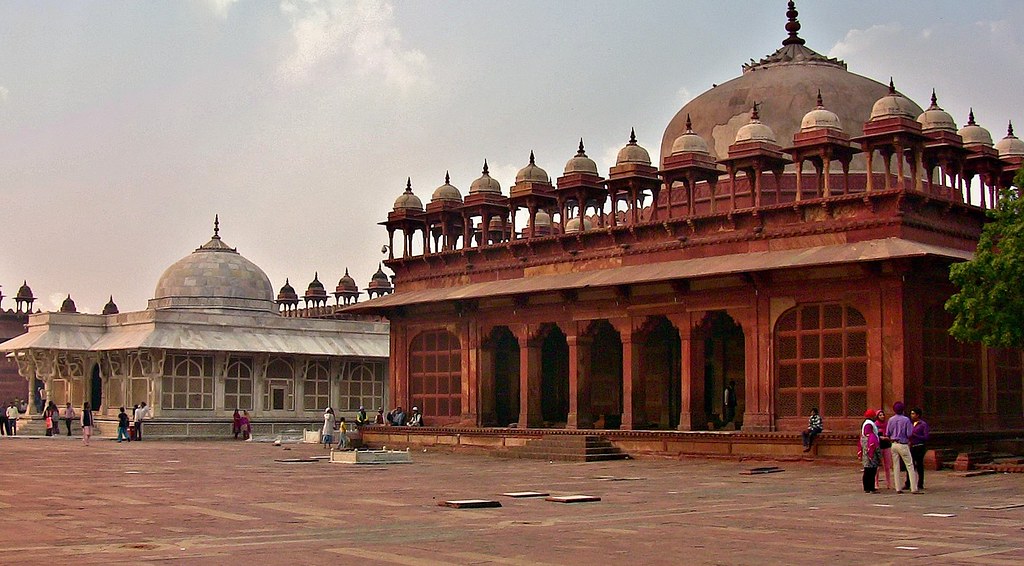
WHAT HAPPENED?
On 11 August 2025, a large group of people claiming a 200-year-old mausoleum in Abunagar (Fatehpur, UP) was originally a Hindu
temple forced its way into the site,
Hoisted saffron flags, chanted slogans and caused partial damage to a tomb; police have registered an FIR and launched an investigation
Timeline and the on-ground sequence
- Before the incident Hindu outfits (led locally by a group called the Math Mandir Sanrakshan/Sangharsh Samiti) and the BIP district leadership publicly demanded permission to hold prayers at the mausoleum and submitted memoranda to district authorities. The BIP district president Mukhlal Pal publicly said he would lead prayers.
- On 11 Aug (the day): Around 150-160 people (reports vary by outlet) broke through barricades set up by police, entered the mausoleum premises, hoisted saffron flags and chanted slogans; videos circulated on social media show people on the structure and some damage being caused to a tomb. Police deployed additional forces including PAc to control the crowd.
- FIR & immediate action: Police registered cases naming a small set of individuals (news reports say
about 10 named) and listing 150-160 unidentified persons; the FIR invokes provisions for unlawful
assembly/rioting, trespass on burial sites and damage to public property (news outlets cite BNS/related penal provisions). Investigations and identification of accused are underway.
The site and the competing claims
- The structure is commonly referred to in reports as Mangi Magbara / Magbara Mangi and is recorded in local revenue records under Khasra No. 753 (listed as “Magbara Mangi /national property'”).
- Locals/organisers claim the building was originally a temple (some leaders even described it as ancient or “a thousand-year-old Thakurji/Shiv temple'”), pointing to motifs (lotus, trident) as evidence. The administration and local records, however, list it as a tomb/maqbara.
Who organised / led the action
- Multiple right-wing Hindu groups and local BIP activists were involved according to reporting. Local leaders of the Math Mandir Sangharsh Samiti and the BIP district president (Mukhlal Pal) are repeatedly named in coverage as calling for the mobilisation. Other outlets and the FIR name specific organisers .
- Legal side — FIR, charges, and possible law-options
- Media reports summarise the FIR as including offences such as promotion of enmity/hatred, unlawful assembly, aggravated rioting, trespass on burial places and damage to public property; some reports point to provisions in the new Bharatiya Nyaya Sanhita being invoked alongside older statutes like the Prevention of Damage to Public Property Act. The FIR reportedly names ~10 accused and lists ~150unidentified persons. This is an investigation-stage FIR-prosecution still needs evidence collection, identification and, if warranted, arrests and chargesheet.
Political & communal fallout
- The incident has raised communal tensions locally. Opposition and local leaders reacted strongly: Congress MP Imran Masood criticised the state response and made a charged remark (saying that if the rioters had been Muslim they would “have been shot in the chest’), which further added heat to the politics around the episode. State leaders urged calm and said the matter was being taken seriously. Several political actors called for strict action against those who disturb communal harmony.
- In response, Mo Naseem, National Secretary of the National Ulama Council, strongly condemned the incident, calling it an attempt to distort history and communal harmony. “It is a centuries-old tomb with graves inside. The place is clearly recorded in government documents. Are we now going to look for temples under every mosque and tomb?” he questioned. Naseem warned that if the district administration fails to stop the program planned for August 11, the Ulama Council will launch protests.
- He criticised the administration for entertaining only one-sided narratives and allowing religious contractors to incite tensions under the guise of faith.
Why this happened — drivers and context
- This episode fits a pattern seen in several Indian towns in recent years: mobilisation around contested religious- heritage claims (claims that pre-existing Hindu temples were converted into Islamic structures), public spectacles (flags/slogans/puja demands), and political mobilisation by local leaders. Such claims are often a mix of genuine local memory, selective reading of archaeological motifs, and political mobilisation. Social media videos amplify incidents quickly, increasing pressure on authorities and communities. Examples of similar flashpoints in the region (saffron flag incidents at shrines) have been reported earlier and are part of the broader context.
Immediate and nedium-term consequences to watch
- Police investigation: identification of named/unidentified accused, arrests (if any), chargesheeting or closure; courts may get involved if people seek protection orders or file petitions.
- Communal temperature: local peace hinges on administration’s restraint and impartial action; political statements can inflame or calm the situation.
- Heritage/record review. if a group pursues a legal claim on historical grounds, the case would likely require archaeological/archival evidence (ASI/State archaeology, revenue records), Official records
(khasra/registration) will be central to the administrative and legal response.
This incident links to multiple GS Paper topics:
GS Paper II – Polity & Governance
Law & Order : Shows the role of district administration and police in preventing mob violence.
Separation of powers: The issue could reach courts if legal claims are made about the site’s religious status.
Communal harmony: Highlights the constitutional duty to maintain public order and protect minority rights (Article 25 – Freedom of Religion).
GS Paper I-History & Heritage
- Religious heritage disputes: The controversy over whether structures were originally temples or mosques/tombs is not new.
- Linked to Places of Worship (Special Provisions) Act, 1991, which freezes the religious character of sites as of 15 Aug 1947 (except Ayodhya).