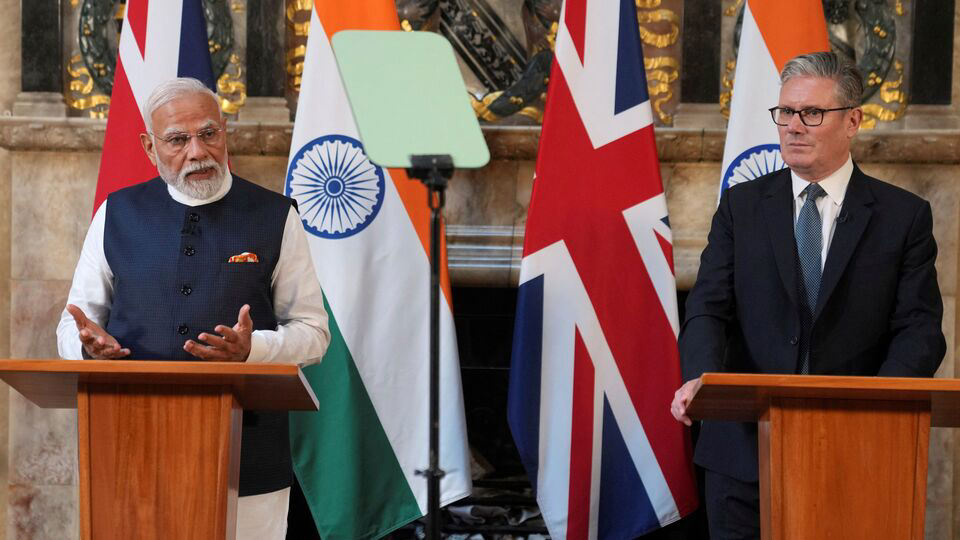
Background and Context
India-UK trade deal:-
- Negotiations began in January 2022 under the Boris Johnson government, and continued through the Sunak administration.
- The deal was finalized under Keir Starmer’s Labour government, shortly after he assumed office in July 2025.
- This is the first major FTA India signed with a Western developed economy and the biggest bilateral trade pact the UK has concluded post-Brexit.
Key Features of the India-UK Free Trade Agreement
Trade Value and Economic Impact
- Current bilateral trade: ~USD 23 billion annually.
- Projected increase post-FTA: ~USD 34 billion per year.
- UK GDP boost: Expected to rise by £4.8 billion annually.
- New investments: ~f6 bilion in joint ventures, startups, green energy, and tech.
Tariff Reductions and Market Access
For Indian Exports to the UK:
- 99% of goods exported by India to the UK to become duty-free immediately or phased out within 5-7years.
- Key beneficiaries:
- Textiles & Apparel (currently facing 10-12% duty).
- Leather & Footwear
- Gems & Jewellery
- Engineering goods
- Auto parts, seafood, and rice
For UK Exports to India:
- Average tariff cut from ~15% to ~3%.
- Major UK exports:
- Scotch whisky & Gin: Tariff halved immediately (from 150% to 75%), reduced to ~30-40% in 10years.
- Luxury cars: Import duties to be reduced from >100% to ~10%, subject to a quota of 25, 000 units annually.
- High-end cosmetics, electronics, dairy products, medical devices, and chemicals.
Services & Skilled Labour Mobility
Eased Mobility Provisions:
- Indian professionals from IT, finance, engineering, law, and consulting will get temporary work permits up to 3 years.
- UK will recognize select Indian professional qualifications (CA, architects, etc)
- Indian chefs, yoga instructors, musicians, etc, will benefit from short-term cultural/work permits.
Social Security Agreement:
- Indian professionals posted temporarily in the Uk will be exempted from paying double social security
(National Insurance) - Saves ~£300 million annually for Indian companies and employees
Government Procurement & Investment Access
UK businesses will get access to Indian federal government tenders above र200 crore (approxse million), especially in:
- Infrastructure
- Clean energy
- Technology
- Railways and airports
India will allow UK investments in sensitive sectors with a more streamlined approval mechanism, especially for:
- Renewable energy
- Semiconductors
- Artificial Intelligence
- Education and EdTech
Education and Research Collaborations
UK to:
- Recognize Indian degrees for admissions and job applications.
- Facilitate student visas and post-study work opportunities for Indian students (up to 2 years)
Joint research funding in:
- Climate change
- Clean tech
- Space science
- Digital public infrastructure
Vision 2035 Roadmap
- Both nations also signed the “India-UK Vision 2035”, which outlines long-term collaboration in:
Sector Areas of Focus
Defence Joint R&D, maritime cooperation, cyber defence
Climate Action Green hydrogen, carbon trading, energy tech
Health Pharma innovation, regulatory cooperation
Technology Semiconductors, Al, 5G interoperability
Education Student mobility, research grants
Startups VC investment, co-incubation programs
Implementation Timeline
- Signed: July 24, 2025
- To be ratified by both:
- Indian Parliament
- UK House of Commons and Lords
- Likely implementation date: Early 2026 (Q1 or Q2)
Challenges & Criticisms
Labour & Environmental Concerns:
- UK trade unions and NGOs flagged:
- Lack of enforceable clauses on labor rights
- Weak language on environmental protection and sustainability
Tax Controversy:
- British media raised concerns over:
- The social security exemption being a “two-tier system’
- Potential for wage imbalances between UK and Indian workers
Indian Farmer Concerns:
- Indian farming communities fear:
- Dumping of cheaper UK agricultural goods
- Competition in dairy and processed foods
Strategic Significance
For India:
- Strengthens Make in India, Act East, and Atmanirbhar Bharat via new export markets.
- Reduces dependence on EU/China.
- Enhances India’s credibility in global FTA negotiations with EU, Canada, and EFTA.
For the UK:
- First major trade breakthrough post-Brexit.
- Positions UK as a pro-India strategic partner in the Indo-Pacific.
- Boosts UK’s economy via access to India’s 1.4 billion-strong consumer market.