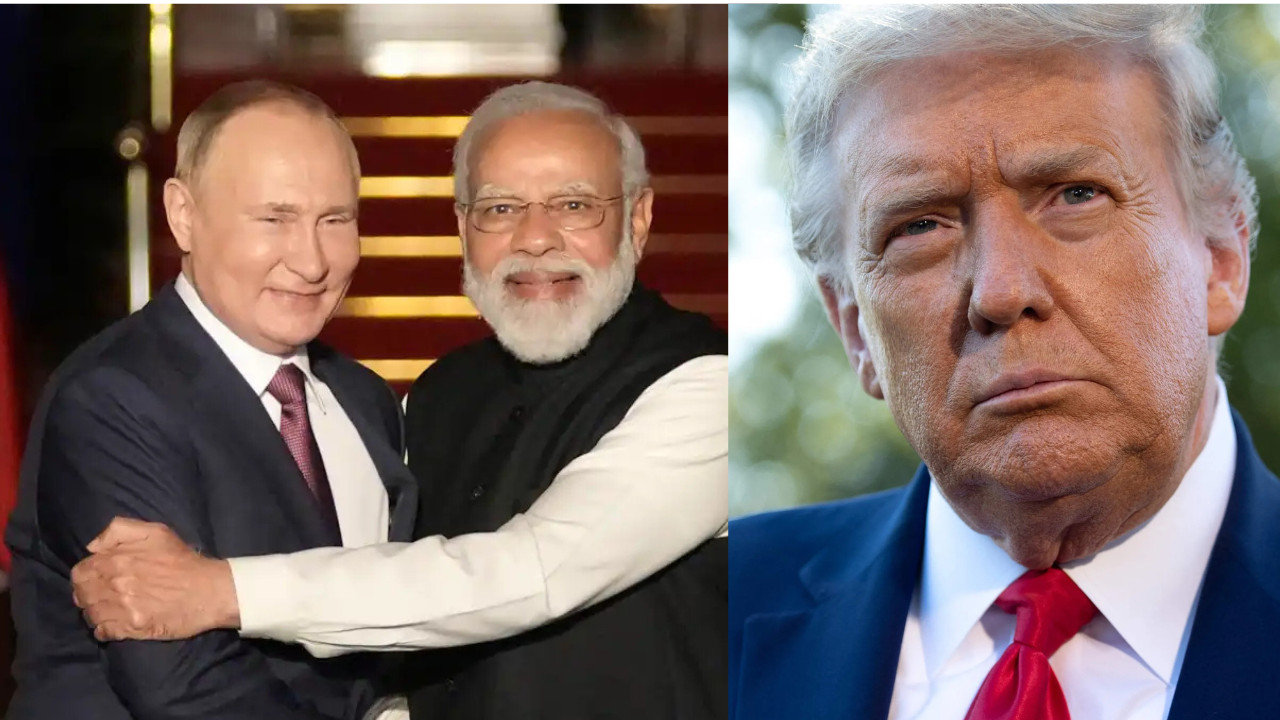
BACKGROUND:U.S. Tariff Escalation Under Trump July 2025
What Happened?
- On July 31, 2025, U.S. President Donald Trump announced:
- A 25% tariff on all Indian imports, effective August 1.
- A further “penalty mechanism” for India’s trade ties with Russia and Iran.
- Public statements branding India and Russia as “dead economies”, calling their currency cooperation “economic sabotage”.
Why Now?
- India has increased defence and oil trade with Russia, despite Western sanctions.
- Russia is aggressively pushing for de-dollarisation (avoiding the U.S. dollar in global trade), using rubles, yuan, and local currencies.
- Trump sees this as a direct threat to the U.S. dollar’s dominance, which is central to America’s economic power.
No Compromise on National Interest
Piyush Goyal was firm that any trade deal would only be agreed to if India’s national interest is not compromised.
Dead Economy’? India Fastest Growing!
Trump has called India and Russia dead economies in a recent post on Truth Social, He posted, “I don’t care what India does with Russia. They can take their dead economies down together, for all I care. We have done very little business with India, their Tariffs are too high, among the highest in the World. Likewise, Russia and the USA do almost no business together….
Goyal’s statement in the Parliament seemed to address this jibe, with the Commerce minister highlighting that India is currently the fastest growing.
“In just over a decade, India has rapidly transformed from being one of ‘Fragile Five’ to the fastest
growing major economy in the world. Today, international institutions and economists see India as the bright spot in the global economy. India is contributing to almost 16% of global growth, ” he said.
India To Be Third Largest Economy Soon
Goyal also pointed to the fact that India ranks among the top five world economies in nominal GDP terms. As per latest International Monetary Fund (IMF) estimates, India is slated to surpass Japan to become the fourth largest by the end of this financial year. IMF estimates also indicate that India will overtake Germany in the coming years to become third largest after the US and China.
“we have risen from the 11th largest economy to one of the top 5 economies driven by our reforms, hard work of our farmers, MSMEs, and entrepreneurs. It is also widely expected that we will become the third largest economy in a few years, ” he said.
March towards ‘Atmanirbhar Bharat
Goyal highlighted that India is progressing towards becoming a ‘self-sufficient’ or ‘Atmanirbhar’economy.
“In the last decade, the government has taken transformative measures to promote India as the manufacturing hub of the world, driven by the ‘Make in India’ initiative.
Trade Deals Need To Be ‘Mutually Beneficial’; Committed To Talks
Goyal spoke extensively on several rounds of trade talks that India engaged in with the US for a trade deal starting March. He said that apart from physical meetings, several virtual discussions have also taken place.
“Our exports have steadily increased during the last 11 years. In an increasingly protectionist world, India has done mutually beneficial trade agreements with UAE, UK, Australia, and EFTA (European Free Trade Area) countries. I We are also committed to similar trade agreements with other countries, ” he said.
Goyal’s statement to the Parliament while sending a message to the US on India’s focus on deals that benefit both countries, also seemed to suggest an openness to engage in trade discussions with America.
India has drawn its red line, and the message is elear: it will not be pressured into an unfavourable trade deal.
The question now is whether the US will back off or recalibrate its approach, recognizing that India will not negotiate on unequal
terms or under coercion.
INDIA-RUSSIA CURRENCY COOPERATION
Key Steps Taken:
01. India and Russia have formally activated rupee-ruble payment mechanisms for key trade sectors like:
- Crude oil
- Fertilizers
- Defence components
02. Both nations are building alternate banking channels, bypassing the SWIFT dollar-dominated payment system.
- Russia’s VTB Bank and India’s UCO Bank are enabling such rupee-based trades.
03. Discussions have taken place over:
- Creating a bilateral financial messaging system
- Linking India’s UPI system with Russian payment networks
- Avoiding U.S.-based clearinghouses entirely
U.S. FEARS & TRUMP’S RESPONSE
Why is the U.S. Alarmed?
- The U.S. dollar underpins global finance: 88% of all forex transactions, over 60% of global reserves.
- If major economies shift trade to local currencies, it reduces:
- U.S. monetary control
- Sanctions power
- Global debt demand for U.S. Treasury bonds
Trumps Countermoves:
- Tariffs as economic punishment to countries promoting dollar alternatives.
- Threatened additional 10%-50% tariffs on BRICS+ countries involved in currency realignments.
- Publicly questioned India’s loyalty to the “Western monetary system”.
BRICS CONTEXT:De-Dollarisation?
BRICS 2025 Agenda:
- Discussions on creating a common settlement currency (informally dubbed the “BRICS currency’”).
- Expanded membership now includes Iran, Saudi Arabia, UAE, Egypt, etc.
- Talks on integrating digital payments platforms like:
- BRICS Pay
- Cross-border CBDC systems
- Digital yuan interoperability
India’s Stance on BRICS Currency:
- India has publicly rejected the idea of a common BRICS currency.
- It maintains that:
- The rupee should be internationalised, but not at the dollar’s expense.
- Reserve currency status is earned by stability and openness, not political opposition to the U.S
ECONOMIC IMPACT ON INDIA
Short-Term Risks:
- U.S. tariffs will raise costs for Indian exporters in sectors like:
- Textiles
- Pharma
- Gems & jewellery
- Financial markets saw stock volatility and rupee depreciation post-announcement.
Long-Term Strategic Opportunity:
- Encouragement for rupee internationalisation.
- India may expand bilateral trade in local currencies with:
- UAE
- Saudi Arabia
- Malaysia
- Singapore
Has Trump boxed the US into a corner?
By publicly deriding India and slapping tariffs on its exports, Trump may have overplayed his hand. Rather than pushing India toward compromise, his comments have likely made it politically impossible for New Delhi to be seen as yielding. India now finds itself in a position where public perception, domestic politics and economic strategy all align in favour of resistance.Yielding to US demands would not only be unpopular at home, it would be interpreted as strategic weakness abroad too.
The US, too, has much to gain from deeper trade ties with India particularly as it seeks to diversify supply chains away from China and tap into India growing consumer market.With India making it clear that unilateral pressure tactics won’t work, Washington may be forced to rethink its strategy.The US could either entrench further, risking a prolonged standoff, or shift to a more diplomatic respect-based dialogue to find common ground