Pakistan-Saudi Arabia Mutual Defence Pact (September 2025)
Key Announcement
- On 17 September 2025, Pakistan and Saudi Arabia signed a “Strategic Mutual Defence Agreement” in Riyadh.
- The agreement declares: “Any aggression against either country shall be considered aggression against both”
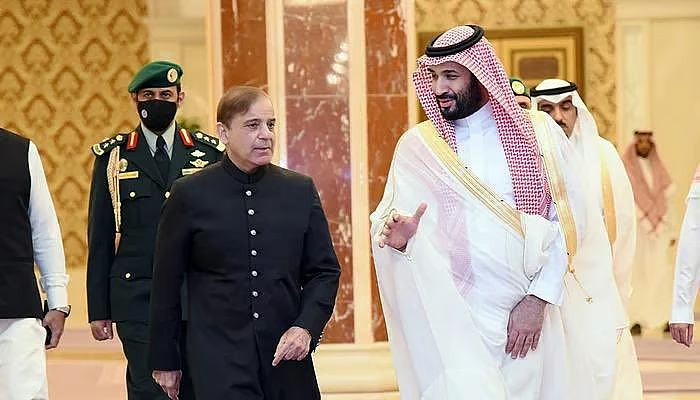
- Signed during PM Shehbaz Sharif’s state visit to Saudi Arabia at the invitation of Crown Prince Mohammed bin Salman (MbS)
Core Features of the Agreement
1. Mutual Defence Clause
- Both states commit to respond jointly if either faces aggression.
2. Scope of Cooperation (as reported)
- Enhanced military cooperation
- Joint deterrence against external threats
- Intelligence sharing
- Joint military training & exercises
- Possible logistics & access agreements (air/sea facilities)
3. Ambiguity in Implementation
- The full text is not public.
- No clarity yet on thresholds, definitions of “aggression, ” or exact procedures for triggering obligations.
Political & Security Context
- The deal follows regional instability, particularly:
- Israeli airstrikes in Qatar targeting Hamas leaders, alarming Gulf states.
- Broader concerns over U.S. security reliability in the Middle East.
- Both Riyadh and Islamabad see this pact as formalizing decades-long defence ties and sending a strong deterrent message.
Nuclear Dimension
- Pakistan is a nuclear-armed state.
- (“all necessary means”) raises questions on whether Saudi Arabia gains indirect access to Pakistan’s nuclear umbrella.
- No explicit mention of nuclear guarantees in public statements.
- Risks include:
- Deterrence ambiguity – adversaries unsure if nuclear retaliation is possible.
- Proliferation concerns – scrutiny from global non-proliferation advocates.
- Strategic instability – miscalculations by regional rivals.
Reactions & Regional Implications
- Iran: Sees pact as part of a bloc against Iranian influence in the Gulf (e.g., Yemen, Syria, Irag)
- United States: Interpreted as Gulf states diversifying beyond U.S. security guarantees, though not an outright rejection of Washington.
- Israel & others: May see this as Gulf militarization complicating de-escalation efforts.
Impact on India
Strategic Concerns
- Closer Pakistan-Saudi ties worry India because Riyadh is a key player in South Asia-Middle East geopolitics.
- If Saudi Arabia provides Pakistan with stronger economic, military, or political backing, it could embolden Islamabad in its policies towards India (especially on Kashmir and terrorism issues).
- The “attack on one = attack on both” clause could make Saudi Arabia more vocal in supporting Pakistan during India-Pakistan disputes, at least diplomatically.
Energy & Economic Dimensions
- India is the largest buyer of Saudi oil (over 18% of India’s crude imports come from Saudi Arabia).
- If Saudi Arabia prioritizes Pakistan in defence and security relations, India may fear potential political conditions tied to oil tr…
Diplomatic Impact
- India has invested heavily in India-Saudi relations in the past decade (defence cooperation, diaspora welfare, investment, energy).
- Riyadh will try to reassure India that the pact is not directed against New Delhi (as Saudi officials already hinted in statements).
- But India will still reassess its Gulf diplomacy, especially with Saudi Arabia, and may strengthen ties with UAE, Iran, and Israel to offset this new alignment.
Risks & Challenges
- Entrapment risk – one state may be pulled into conflicts not directly involving it.
- Escalation – broad wording could escalate small incidents into regional crises.
- Diplomatic fallout – may strain Saudi relations with India and others.
- Operational limits – Pakistan’s ability to sustain forces in the Gulf is limited by logistics
Expected Consequences
- Short-term (weeks-months): announcements of joint drills, intelligence-sharing expansion, diplomatic consultations.
- Medium-term (6-24 months): deeper institutional cooperation, possible logistics or base-access deals
- Long-term (years): reshaping Gulf security architecture by reducing exclusive reliance on the U.S. and increasing regional defence blocs.
What Remains Unclear
- The full legal text of the pact
- Exact trigger mechanisms for mutual defence.
- Whether nuclear deterrence is formally or informally included.
Bottom Line
- The Pakistan-Saudi Arabia defence pact is a historic formalization of long-standing military ties, signalling
unity against threats. - It represents a major geopolitical shift in Gulf security, but the lack of clarity on triggers, scope, and nuclear dimensions leaves open serious strategic and legal questions.